

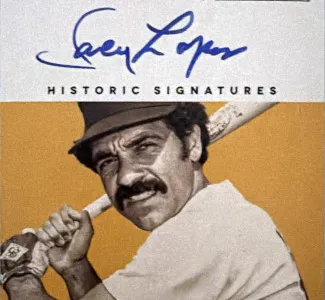
The month of April was a bad one for hard-working, talented, All-Star National League second basemen who later went on to manage in the majors. And who had great moustaches. We’ll get to Phil Garner soon, but first we’ll pay respects to Davey Lopes, one of the best baserunners ever and part of one of the all-time great infields. Lopes, 80, died on April 8 in East Providence, RI, from Parkinson’s disease. He played for the Los Angeles Dodgers (1972-81), Oakland Athletics (1982-84), Chicago Cubs (1984-86) and Houston Astros (1986-87).
David Earl Lopes was born in East Providence on May 3, 1945. He was the fourth of 10 children belonging to Mary Rose Sylvia. His father, who was part Portuguese and part African-American, was never in the picture. The family grew up poor, and Lopes later said that he took to shoplifting at an early age, using his speed to get away. “I never stole anything major, just clothes and baseballs and bats,” he told Los Angeles Times columnist Jim Murray in 1974. After spending a night in jail, he looked for better opportunities outside of Rhode Island. Interestingly, despite the acclaim he would win over his long career, Lopes never became a local hero. Getting drafted into pro ball barely made a ripple in the local news, and Lopes wasn’t surprised. “If you were from the right side of the tracks, you became a celebrity,” he said in 1988. “If you weren’t, you were ignored. That’s just the way it was. It was black and white. Literally.”
Source: The Spokesman Review, April 12, 1971.
Lopes was a very good basketball player at La Salle Academy and earned a scholarship to play at Iowa Wesleyan University when he graduated in 1964. However, at 5’9″, basketball wasn’t going to be in Lopes’ future. Fortunately, he had been building up a serious baseball resume, starting in Little League. Lopes played basketball and baseball in college, first with Wesleyan and then Washburn College in Topeka, KS. He was an NAIA All-American at both sports, and his speed and occasional pop made him an ideal center fielder. Lopes batted .470 with 9 homers and 24 RBIs in 19 games for Wesleyan in 1966 and hit .380 with 20 stolen bases for Washburn in 1967. The San Francisco Giants drafted Lopes in the Eighth Round of the 1967 Amateur Draft, but he elected to complete his education. He graduated in 1968 with a degree in education and signed with the Los Angeles Dodgers, who had selected Lopes in the Second Round of the 1968 January Draft – Secondary Phase.
Lopes was already 23 years old when he broke into pro ball, and he was one of the older players on the Daytona Beach Dodgers of the Florida State League. He couldn’t play regularly for his first few seasons because he had to split his summers between baseball and the Army Reserves. He showed a little pop in his bat and played a decent outfield, but his baserunning was the standout feature. In 82 games in 1968, Lopes batted .247, and he stole 26 bases in 33 attempts. The following year, while still in Daytona Beach, he stole 32 bags in 72 games and was caught just 4 times. He also batted .280 and hit 9 home runs. The Dodgers moved him to Spokane of the Triple-A Pacific Coast League in 1970, and Lopes batted .262 in 100 games with 6 home runs. He also began playing second base more regularly. It came at the suggestion of Spokane manager Tommy Lasorda, and it wasn’t much of a suggestion, if Murray’s 1974 article is accurate. Lopes supposedly refused the move at first and threatened to go home. “That’s a good idea,” Lasorda said, according to the columnist. “Maybe they’ll let you play the outfield on the thread factory team.” Whether that encounter happened or not — Lasorda’s comments were probably a little more colorful — Lopes made the move. He wasn’t comfortable at second base initially, but he won over Lasorda pretty quickly. “In two years, he’s going to be a great second baseman. And we are going to be in dire need of second basemen,” the manager said.
Lopes worked hard to improve his defense, and he also paid attention to the other fine points of the game. During spring training, Dodger MVP and stolen base king Maury Wills would demonstrate base-stealing to the rookies at training camp. “There we were, two hundred guys sitting in the Florida sun,” Lopes later recalled. “One hundred of them were sleeping, but I figured any guy who stole a million dollars with his feet was worth staying awake for, because he sure didn’t do it by sleeping.” Lopes put together all the parts of his game that would make him an All-Star — his hitting, his defense, his baserunning — but he still didn’t reach the major leagues until the tail end of the 1972 season, when he was 27 years old. He started the final 11 games for the Dodgers, with his first game taking place on September 22 against the San Francisco Giants. He went 0-for-5 in that game and 0-for-2 in his next, though he walked 3 times and stole a base. Lopes singled twice on September 24 off Giants starter Jim Barr, and he scored 2 runs in a Dodgers 7-0 win. The rookie batted .214 in those first 11 games, with 4 doubles and 4 stolen bases. He committed 2 errors in 56 chances at second base for a .964 fielding percentage.
Dodgers manager Walt Alston added Lopes to LA’s Opening Day roster in 1973, but he kept the rookie as a bench bat or defensive replacement for the first two weeks of the season. But when Lopes finally got a chance to start at second base, he didn’t let the opportunity go. He began May by recording at least one hit in 13 of his first 14 games, and he stole 13 bases before he was finally caught for the first time. He hit his first career home run off Barr and the Giants on May 13, 1973. His 2 hits on the day left him with a .358 batting average, and he had essentially claimed the position for his own. The 1973 Dodgers also had Bill Russell at shortstop and Ron Cey at third base, and first base was shared by Steve Garvey and Bill Buckner. Buckner stayed with the Dodgers through 1976 before he was traded to the Cubs, but the other four players formed one of the best starting infields of the last 60 years — and definitely the longest tenured. Garvey, Lopes, Russell, and Cey remained together through the 1981 season and were key figures in some of the team’s greatest moments. Lopes finished sixth in the NL Rookie of the Year vote after ending ’73 with a .275/.352/.351 slash line. He stole 36 bases and was caught 16 times, and he drew 62 walks.